
This post contains affiliate links, which means we may receive a small commission, at no additional cost to you, if you make a purchase through these links. See our full disclosure here.
I have a complicated relationship with aluminum luggage.
I love how it looks. I love the click of a proper latch, the rigidity, the old-school trunk feel, and how luxurious it feels. But I don’t love carrying 11 pounds of empty suitcase up a flight of stairs.
Over the past few years, I’ve tested quite a few aluminum suitcases, including some that didn’t make it into this guide. The ones I liked best are from MVST, Sterling Pacific, LEVEL8, and Carl Friedrik. I’ve also included the aluminum-framed Monos Hybrid Carry-On, which isn’t full aluminum but has been with me on many journeys, and I think it deserves to be in this list.
My favorite for most travelers is the MVST TREVA. It gives you the build, zipperless construction, and unmistakable look of full aluminum luggage without wandering into four-figure territory. There are more beautifully made cases here, and others I prefer in certain ways, but the TREVA is the one I’d recommend most easily.
Our Aluminum Luggage Picks at a Glance
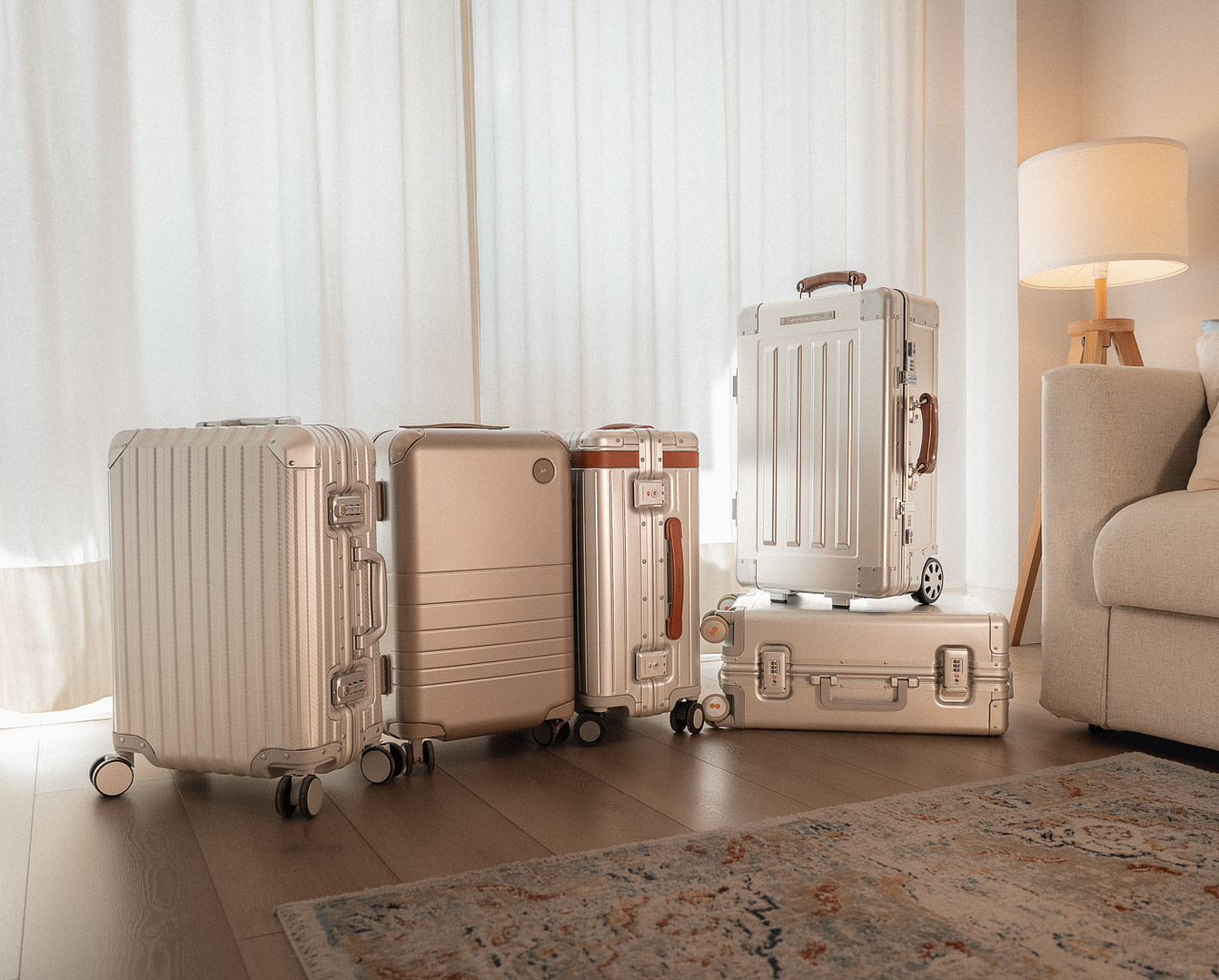
We don’t have 18 aluminum suitcases in a test laboratory. These are the ones we’ve actually traveled with.
Swipe to compare →
| Suitcase | Dimensions | Weight | Capacity | Best for | Our experience |
| MVST TREVA | 21.7 × 14.8 × 8.7 in 55 × 37.5 × 22 cm | 9.37 lb 4.25 kg | 34 L | Best overall | Weekend trips, ski trip, cobblestones, sand, and rough handling |
| Carl Friedrik Aluminum Carry-On | 21.7 × 15 × 9.1 in 55 × 38 × 23 cm | 10.8 lb 4.9 kg | 41 L | Design and packing space | Marrakech and Ryanair cabin travel |
| Sterling Pacific 35L | 22.5 × 14 × 8.5 in 57.2 × 35.6 × 21.6 cm | 11.5 lb 5.22 kg | 35 L | Craftsmanship | Road trips and city breaks |
| LEVEL8 Gibraltar | 22 × 15 × 8.4 in 55.8 × 38.1 × 21.3 cm | 10 lb 4.54 kg | 36 L | Smooth wheels and minimalist design | Owned for years; short trips and photoshoots around Andalusia |
| Monos Hybrid Carry-On | 22 × 14 × 9 in 55.9 × 35.6 × 22.9 cm | 9.7 lb* 4.40 kg | 34.2 L | Hybrid alternative | 5 years of flights, trains, buses, and road trips |
Prices and specifications checked in October 2026. Prices may change.
*Our older Monos test model was listed at 8.81 lb/36 L. Monos has since revised the current Hybrid Carry-On specifications.
A Quick Note About Carry-On Size
Every suitcase in this guide is sold as a carry-on, but that doesn’t mean every one meets every airline’s limits. And unlike soft luggage, aluminum isn’t going to squeeze into a sizer if it’s a little too big.
This is important, especially in Europe. Ryanair, for example, limits its 22 lb (10 kg) overhead cabin bag to 21.7 × 15.7 × 7.9 inches (55 × 40 × 20 cm), which technically makes several of these cases too deep. My Carl Friedrik is 21.7 × 15 × 9.1 inches (55 × 38 × 23 cm), yet I’ve put it in the Ryanair sizer twice, and it fit both times. That’s my experience, though, not a guarantee that another gate agent will let it through.
Always check the dimensions and weight against the airlines you actually fly before buying.
How We Test Luggage
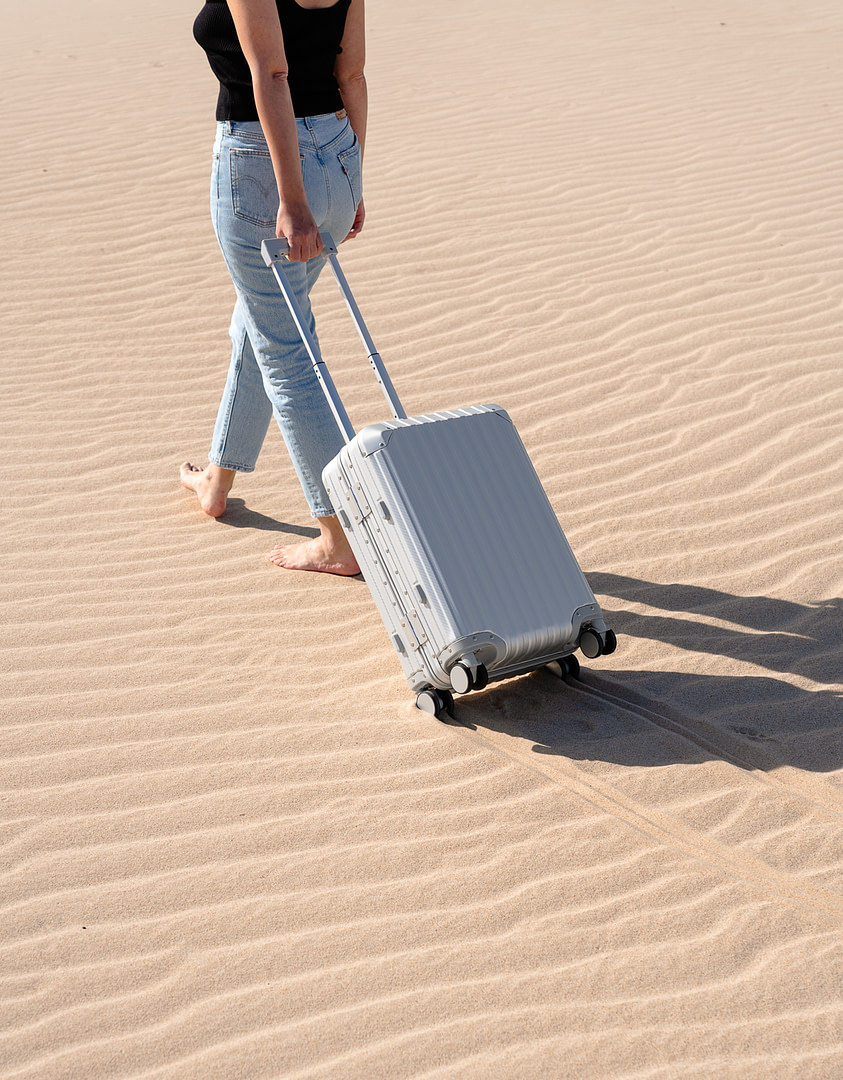
We don’t have a laboratory where we roll suitcases around a mechanical track for 50,000 miles or drop them from a crane.
We have airports, cobblestones, stairs, taxis, hotel carpets, train stations, overhead bins, and occasionally a Moroccan porter who grabs a brand-new suitcase and races it through the medina in a metal cart.
Every suitcase recommended here has traveled with us. We pack them for real trips and pay attention to how they roll when full, whether the handle starts wobbling, how annoying the latches are when we’re in a hurry, whether the interior actually makes packing easier, and how much the empty weight eats into an airline allowance.
With aluminum cases, I also look at how the shell holds up to real travel. How quickly does it scratch? Where does it dent? Do the corners take most of the beating? Does the frame still line up properly after a few trips? I also pack them full to see how easy they are to close, because unlike polycarbonate or soft-sided luggage, there’s very little give when you need just a bit more room.
MVST TREVA: Best Overall
- Best for: Travelers who want full aluminum without luxury-brand pricing
- Dimensions: 21.7 × 14.8 × 8.7 in / 55 × 37.5 × 22 cm
- Price when checked: From $399
- Weight: 9.37 lb / 4.25 kg
- Capacity: 34 L
- Warranty: Limited lifetime; covers shell cracks or breaks and unusable wheels or handles, but not cosmetic dents, scratches, or airline damage.
- Tested: Several weekend trips, a week-long ski trip, airports, cobblestones, sand, dirt, and intentional drops
The MVST TREVA isn’t the fanciest aluminum suitcase here, but it gets the balance right: full aluminum construction, excellent wheels, proper latches, useful organization, and the lowest price among the full-aluminum cases on the list.
There is a little history to our test model. I originally reviewed the MVST TREK, which has since evolved into the TREVA. The overall design is very similar, but the current version uses stronger 5083-O aluminum and MVST’s newer RIVA tri-bearing wheels.
So, if you’ve been researching this suitcase for a while, you’ll still see both TREK and TREVA mentioned online.
Read more
What I like
Smooth aluminum can advertise every little scrape, but the TREVA’s textured case hides minor marks surprisingly well.
The wheels are slightly larger than average and handle rough ground well, which is important to me because much of my travel happens in Europe, where the walk from a beautiful old hotel to the train station involves several hundred yards of cobblestones.
I particularly like the slow-release grab handles. Lift one and let go, and instead of snapping back against the case, it slowly lowers itself into place. It’s a small detail, but one I miss on aluminum cases that don’t have it.
Inside, the compression system makes good use of the 34 liters.
What I don’t like
Thirty-four liters is still 34 liters. If you’re a chronic overpacker, buy something else. Aluminum doesn’t stretch, the case doesn’t expand, and there comes a point where no amount of sitting on the lid will change the laws of physics.
The telescoping handle on my test model also had a little more play at full extension than I’d like. It has never caused a problem, but there are firmer handles among the cases in this guide.
Then there’s the weight. At 9.37 pounds empty, the TREVA is reasonable for aluminum, but I’d think twice about it if I regularly flew with a strict 15 to 18 lb (7 to 8 kg) cabin allowance.
On the road
I’ve been much rougher with the MVST TREVA than with other suitcases in this list.
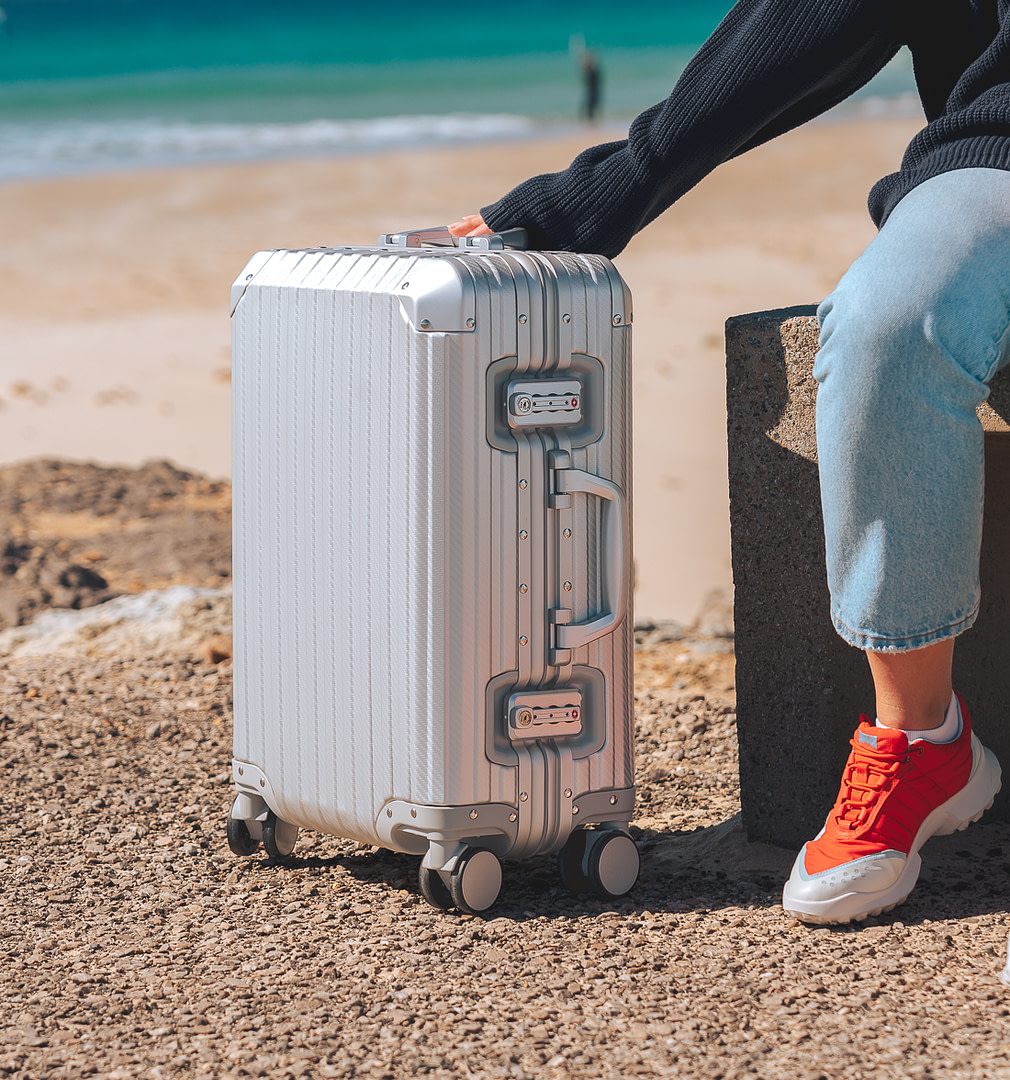
During a photoshoot on the dunes at Punta Paloma near Tarifa, I rolled it through sand for hours, sent it down dunes, and dragged it over plenty of uneven ground. Some of that fine sand eventually worked its way inside the case, and I had to vacuum it out and give the suitcase a proper clean afterward.
It’s also been on several flights and survived a few intentional drops. It has picked up some marks, but nothing that bothers me. More importantly, the wheels still roll smoothly and the latches work exactly as they should.
I wouldn’t buy the clear protective cover and then spend my life trying to preserve the suitcase in museum condition. Part of the point of aluminum is watching it age.
I’ve taken it to Mykonos, used it for weekend trips, and packed it for a week-long ski trip with a weekender alongside it. I’ve managed to fit five sweaters, three pairs of pants, underwear, and the usual extras inside. So while 34 liters isn’t huge, in practice I’ve rarely found it too small.
Read our full MVST TREVA review →
Carl Friedrik Aluminum Carry-On: Best Design
- Best for: Design and packing space
- Dimensions: 21.7 × 15 × 9.1 in / 55 × 38 × 23 cm
- Weight: 10.8 lb / 4.9 kg
- Capacity: 41 L
- Price when checked: $945
- Warranty: Lifetime warranty; depending on the problem, Carl Friedrik may send a replacement part, repair the suitcase in-house, or replace it.
- Tested: Marrakech, airports, rough city streets, overhead bins, and Ryanair cabin travel
The Carl Friedrik Aluminum Carry-On is the most elegant aluminum suitcase here, at least to me. It’s beautifully made without going quite as industrial as the Sterling Pacific, and there are some clever details I wish more luggage brands would copy.
Read more
What I like
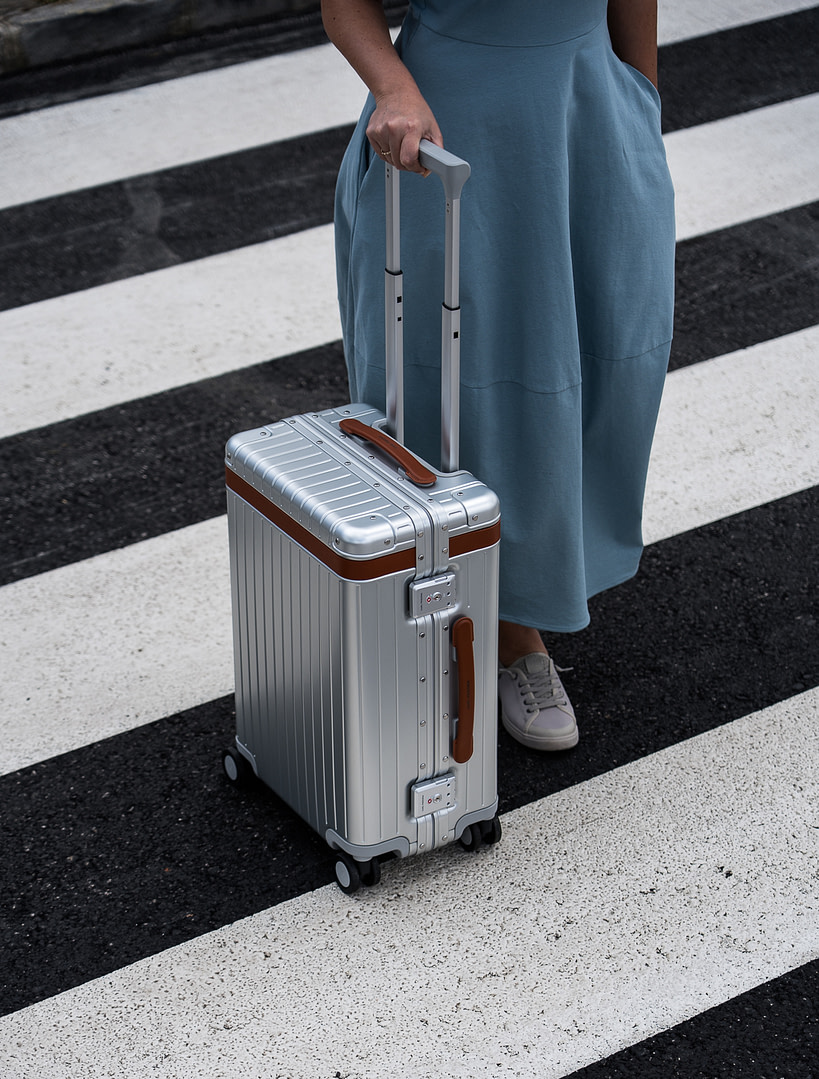
The design is beautiful. You still get the grooves, rivets, and industrial look of aluminum, but the Vachetta leather handles change the whole feel of it. It’s more old luxury hotel than aviation equipment.
The Hinomoto wheels are smooth and fast, but my favorite feature is the trolley handle. Carl Friedrik’s any-stop system locks wherever you stop pulling it instead of giving you two or three predetermined heights. There’s very little play at full extension, too.
The latches are excellent: solid, easy to use, and very satisfying to close.
It’s also the roomiest full-aluminum carry-on here at 41 liters, and you can feel those extra liters when you pack.
What I don’t like
For such a beautiful exterior, I expected to love the interior equally. I don’t.
One half zips closed, which I like. The other uses a removable compression pad and Y strap. It works, but when I tighten the strap, I’m left with loose material that has nowhere to go.
The weight is another drawback. At 10.8 pounds empty, it’s one of the heavier cases in this guide.
On the road
The Carl Friedrik’s first trip was to Marrakech, and any plans I had to baby it lasted about five minutes.
Shortly after we arrived, a porter grabbed my brand-new suitcase, threw it into a battered metal cart, and took off through the medina. I followed behind watching my pristine case bounce over the uneven streets and wondering what it was going to look like by the time we reached the hotel. It was perfectly fine.
I was only in Marrakech for three days, but I had clothes, sandals, toiletries, makeup, camera gear, and plenty of other stuff with me. I still had space left, which almost never happens. At 41 liters, this is the roomiest full-aluminum carry-on here, and I definitely made use of it.
I was less sure how I’d get on with Ryanair. At 9.1 inches (23 cm) deep, the case is technically 1.2 inches (3 cm) over the limit. I put it in the sizer in Málaga anyway, and it fit. Then I tried again in Marrakech on the way home. Same result. I wouldn’t assume it’ll fit every time, but so far, I’m two for two.
Read our full Carl Friedrik Aluminum Carry-On review →
Sterling Pacific 35L Cabin Travel Case: Best Craftsmanship
- Best for: Exceptional craftsmanship and materials
- Dimensions: 22.5 × 14 × 8.5 in / 57.2 × 35.6 × 21.6 cm
- Weight: 11.5 lb / 5.2 kg
- Capacity: 35 L
- Price when checked: $1,950
- Warranty: Lifetime Warranty & Service Promise; Sterling Pacific supplies spare parts such as locks and leather handles for simple DIY repairs for life.
- Tested: Several road trips and city breaks, airports, overhead bins, hotel carpets, and European cobblestones
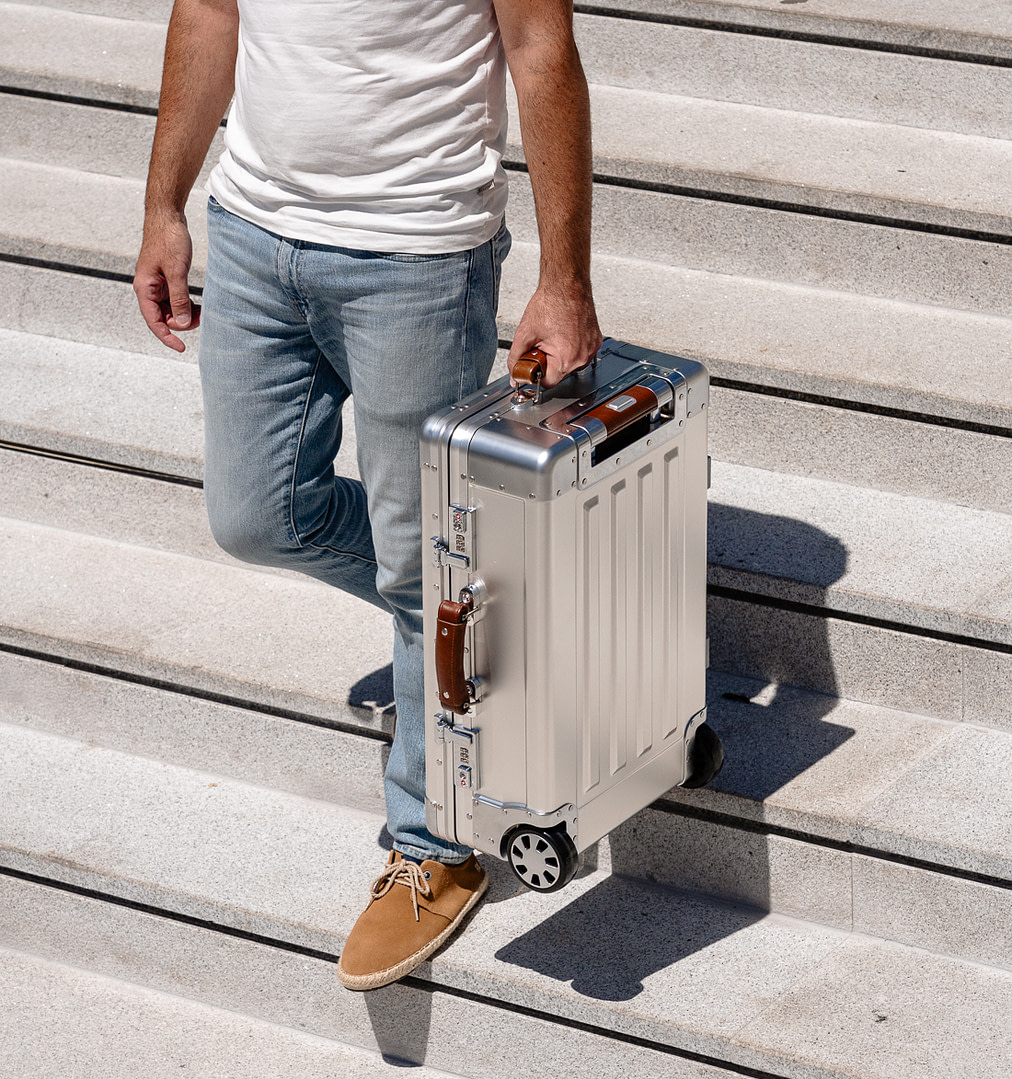
The Sterling Pacific 35L Cabin Travel Case costs a small fortune, weighs more than most aluminum carry-ons, and has only two wheels. But God, I love it.
There’s barely any plastic to speak of. Aluminum body, aluminum frame, aluminum wheel housings, aluminum trolley housing, full-grain Italian leather handles, and more than a hundred rivets holding the whole thing together. It’s a stunning piece of industrial design, and when you have it in front of you, you can see where the money went.
Read more
What I like
When the 35L Cabin Travel Case arrived, I thought it was the most beautiful piece of luggage I’d ever seen. I was almost afraid to use it.
The biggest surprise, though, was the two-wheel design. I was skeptical. Four-wheel spinners have become so standard that going back to two wheels on a suitcase this expensive seemed eccentric.
But these aren’t typical suitcase wheels. They’re 2.5 inches in diameter, partially recessed into the case, and much larger than the little spinner wheels I’m used to.
I also really like the 80/20 trunk-style interior. Instead of two shallow halves, most of the depth sits in one compartment, which I find much easier for shoes, hair tools, sweaters, and other bulky things.
Those leather handles feel wonderful in the hand and give all that cold aluminum a bit of warmth.
What I don’t like
It weighs 11.5 pounds empty.
There is no getting around it. This is a very heavy carry-on, and on an airline with a strict 15 lb (7 kg) cabin allowance, more than half of your allowance is gone before you’ve packed your underwear.
Two wheels also aren’t for everyone. They’re brilliant outside, but I sometimes miss being able to turn the case sideways and roll it beside me through a crowded airport or a narrow queue.
And, obviously, the price is extraordinary. Even on sale, we’re talking about well over $1,500 for a carry-on.
On the road
The first time I took the Sterling Pacific over cobblestones, the two-wheel design finally made sense. Those big wheels just rolled over gaps that normally have small spinners wobbling, catching, or forcing me to drag the suitcase behind me. On old European cobblestones, they’re the best I’ve used.
I’ve taken it on several trips now, including Christmas in Madrid, and I’ve also flown with it without having any trouble getting it into the overhead bin. That includes Norwegian Air, despite the 22.5-inch height.
The aluminum has been easy to clean, the wheels remain excellent, and I expect the leather handles to become more interesting with age.
For a weekend away, I pack my clothes and packing cubes into the deep main compartment and use the shallower lid for toiletries, chargers, and smaller things. Packing cubes work really well in that trunk-style space.
And I’ve become much less precious about it. On the first trip, I was watching every wall, curb, and luggage rack. Now, I just use it.
Sterling Pacific vs. Rimowa
The Sterling Pacific 35L and Rimowa Original Cabin have more in common than you might think.
Both are well-made aluminum carry-ons with zipperless closures, 35-liter capacities, and lifetime warranties. More importantly, they appeal to much the same kind of traveler: someone who appreciates beautiful luggage and is willing to pay for it.
Personally, I think the Sterling looks more luxurious. Those leather handles, exposed rivets, and all-metal details make it stand out even next to the iconic Rimowa.
The biggest practical difference is the wheels. Rimowa has four excellent spinners, while Sterling has two large, partially recessed wheels. I’ve used the Sterling on European cobblestones several times, and it’s brilliant on them. My time with Rimowa was limited to one short trip, mostly on smooth airport floors, so I can’t say how it would compare on rough ground.
They also pack differently. I love Sterling’s 80/20 trunk-style interior for bulky items, while Rimowa’s Flex Dividers are great at keeping everything in place.
Rimowa does have a clear advantage in weight: 9.5 pounds versus Sterling’s 11.5. And being able to roll it beside you on four wheels is more convenient in airports.
If I had to choose, I’d take the Sterling Pacific. I know the Rimowa is more practical in certain ways, but at these prices, I want something with a bit more character. And I think the Sterling has plenty of it.
Read our full Sterling Pacific 35L review →
LEVEL8 Gibraltar: Best Wheels
- Best for: Minimalist design and excellent wheels
- Dimensions: 22 × 15 × 8.4 in / 55.8 × 38.1 × 21.3 cm
- Weight: 10 lb / 4.5 kg
- Capacity: 36 L
- Price when checked: $459.99
- Warranty: Lifetime warranty covering functional problems with the shell, wheels, handles, and other components; airline damage and normal wear are excluded.
- Tested: For several years; trips around Andalusia and to Comporta, Portugal, plus several photoshoots
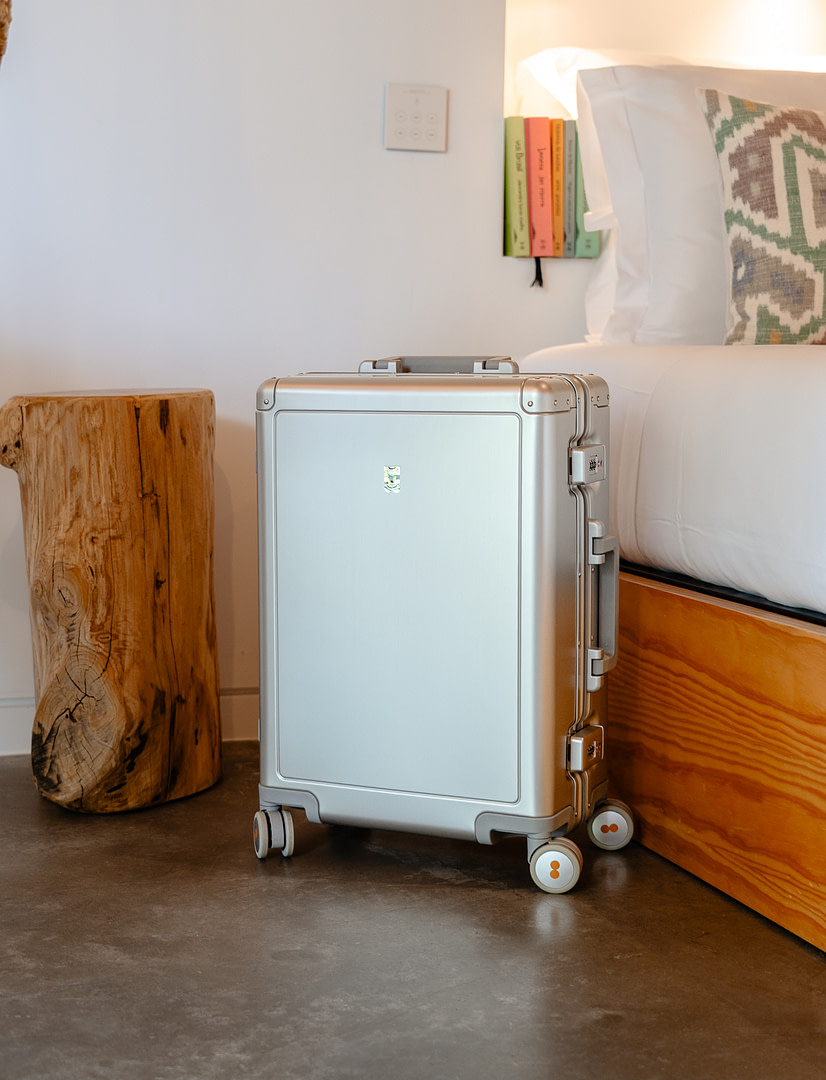
The LEVEL8 Gibraltar is probably the most overlooked aluminum suitcase in this guide. It doesn’t have the craftsmanship of the Sterling Pacific, the design details of the Carl Friedrik, or the value argument of the MVST.
But there’s very little about it I don’t like. It’s well made, uncomplicated, and one of those suitcases I enjoy every time I come back to it.
Read more
What I like
Of the full-aluminum carry-ons we’ve tested, the Gibraltar has the smoothest wheels. They’re whisper quiet, need very little effort to get moving, and make this 10-pound aluminum box feel lighter than it is.
I also like how little LEVEL8 has done with the design. There’s no unnecessary decoration. It’s just a very clean aluminum case with reinforced corners.
And then there are the grab handles. Let go of one, and it slowly lowers itself back into place instead of hitting the case with a metallic clunk. I love this. It’s a tiny thing, but one I appreciate every time I use it.
Hats off to LEVEL8 for that one.
What I don’t like
I’m less enthusiastic about the interior. It’s practical and there’s enough organization, but it just doesn’t feel particularly special to me. That’s mostly a matter of taste.
The price also needs some context. At $459.99, the Gibraltar currently costs more than the MVST TREVA. LEVEL8 does throw in a four-piece packing cube set and luggage tag with the suitcase, which sweetens the deal a little. Still, if I had to choose between the two, I’d buy the TREVA.
On the road
I’ve owned the Gibraltar for years, although it hasn’t traveled with me nearly as much as the MVST, Sterling Pacific, or Monos.
Most of its trips have been fairly short. I’ve used it around Andalusia, taken it to the countryside last November, and brought it to Comporta, Portugal, one summer. It’s also been with me on a few photoshoots.
The suitcase follows along with very little effort, and for a 10-pound aluminum case, it doesn’t really feel heavy until I have to pick it up.
It’s been pleasantly practical and uncomplicated. Every time I use it, I really like it. And every time, I wonder why I don’t use it more often.
Monos Hybrid Carry-On: Best Hybrid Alternative
- Best for: Travelers who want zipperless luggage without a full-aluminum shell
- Dimensions: 22 × 14 × 9 in / 55.9 × 35.6 × 22.9 cm
- Weight: 9.7 lb / 4.4 kg for the current model*
- Capacity: 34.2 L for the current model*
- Price when checked: $355
- Warranty: Lifetime warranty on core parts such as wheels, handles, and locks; optional paid coverage can add protection for airline damage and impact cracks.
- Tested: Five years of flights, car trips, trains, buses, airports, cobblestones, rain, and city travel
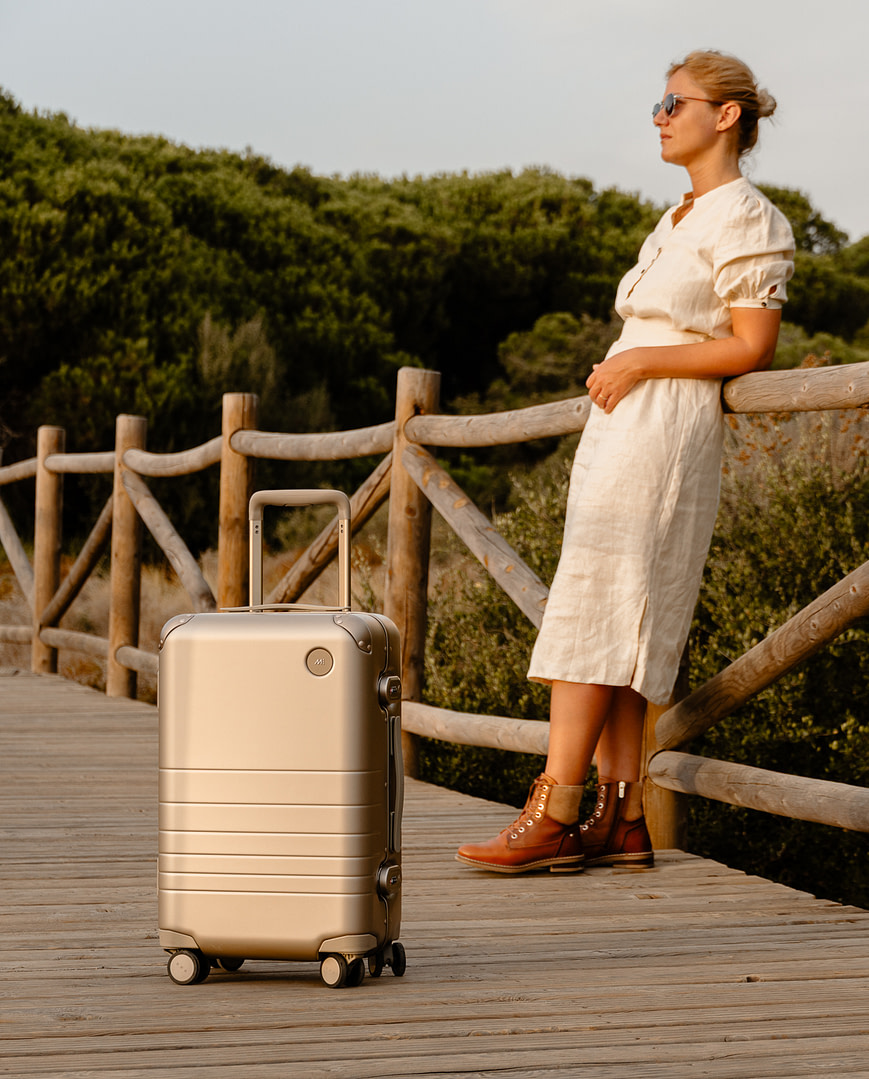
The Monos Hybrid Carry-On isn’t an aluminum suitcase.
Its metallic finish and zipperless aluminum frame make it easy to lump into the same category, but the shell is polycarbonate, reinforced with aluminum around the frame and corners.
Monos now makes a separate full-aluminum collection, but I haven’t tested that one. I’ve tested this one, and after five years, it’s still one of my favorite suitcases.
Read more
What I like
The interior might be my favorite of the group.
One side zips completely closed; the other has a removable compression pad and wide straps. There are enough mesh pockets to organize chargers, magazines, and accessories. I’ve even slipped my laptop, in its protective sleeve, into one of them between my clothes.
I also love the telescoping handle. The release button sits underneath the grip, where your fingers naturally land, and after using it for years, conventional top-mounted buttons feel less intuitive.
The wheels are quiet, smooth, and, more importantly, still quiet and smooth five years later.
What I don’t like
The current model has become fairly heavy. Monos now lists the Hybrid Carry-On at 9.7 pounds, which puts it very close to some of the full-aluminum cases here.
My older test model was originally listed at 8.81 pounds and 36 liters, so the Hybrid I own isn’t identical to the one Monos sells today. If low weight is the reason you’re considering it over full aluminum, the current numbers aren’t especially compelling.
On the road
The Monos is the easiest case here for me to judge because I’ve lived with it for five years.
It’s been on planes, trains, buses, and road trips. I’ve pulled it over the cobblestones of Rothenburg ob der Tauber, shoved it into taxis, lifted it into overhead bins, been caught with it in the London rain, and sat on it at the airport when there was nowhere else to sit.
The wheels are still smooth. The latches still work. The handle still works. The polycarbonate shell has picked up some scratches, but none of the dents that come with full aluminum.
The combination has worked really well for me. I get the zipperless frame and some of the structure and aesthetic of aluminum luggage, but it’s much less precious in everyday use. Mine has become one of those pieces of luggage I can grab without thinking about what the trip is going to do to it.
Read our full Monos Hybrid Carry-On review →
What About Rimowa?

- Why it’s here: The aluminum carry-on everyone wants to compare against
- Dimensions: 21.7 × 15.8 × 9.1 in / 55 × 40 × 23 cm
- Weight: 9.5 lb / 4.3 kg
- Capacity: 35 L
- Price when checked: $1,550
- Warranty: Lifetime coverage for functional damage on suitcases purchased since July 25, 2022; cosmetic wear, misuse, and abuse aren’t covered.
- Tested: Borrowed from a friend for one short trip
You can’t really talk about aluminum luggage without talking about Rimowa.
The German company began experimenting with aluminum luggage in the early days of aviation and introduced its now-iconic grooved aluminum shell in 1950. Today, the Original Cabin is still the suitcase against which almost every new aluminum carry-on gets compared.
But I’m not going to rank it here.
Read more
I’ve traveled with a Rimowa Original Cabin borrowed from a friend for one short trip to Barcelona. That gave me enough time to pack it, roll it, and get a feel for it, but it isn’t equivalent to the months and years I’ve spent with several of the suitcases above.
The Flex Dividers were new to me, and I wasn’t sure what I’d make of them, but they’re very practical. I managed to fit more than enough for the weekend into 35 liters, and the dividers kept everything in place without taking up much room.
The wheels don’t look like anything special, but on smooth airport floors, they’re excellent. I took a taxi from the airport straight to the hotel, so I didn’t get the chance to try them on cobblestones or rough ground. I can’t say how they’d compare with the Level8 or Sterling Pacific there.
The stage-free telescoping handle works much like the one on the Carl Friedrik, and it’s a dream to use. You stop it exactly where you want it rather than choosing from a few fixed heights. The grab handles have the same slow return I like so much on the LEVEL8, and opening and closing the case is effortless.
So, yes, I get the appeal. It’s a great suitcase.
Would I pay $1,550 for one? Probably not. It isn’t my favorite of the cases I’ve tried here. But I also don’t think the price comes out of nowhere. You’re paying for the construction, the brand, and decades of Rimowa history.
What Aluminum Luggage Is Actually Like to Travel With
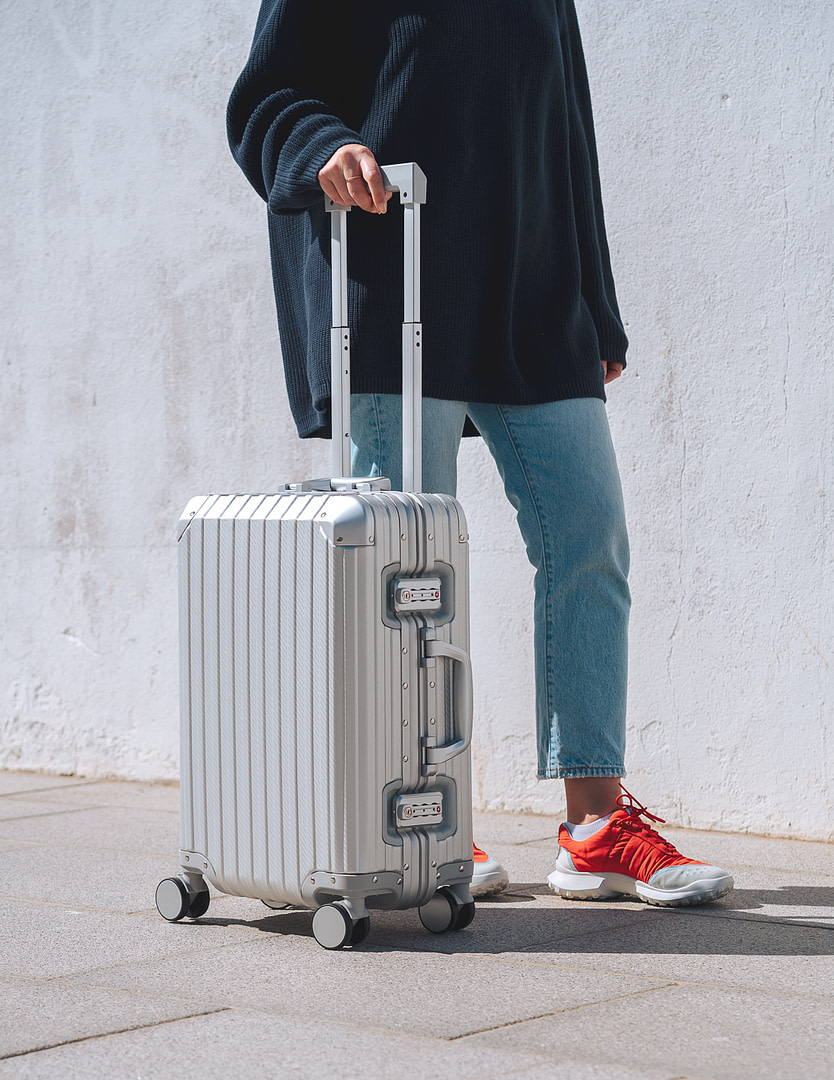
Aluminum luggage photographs beautifully, but traveling with it is more complicated.
It is heavy
This is the one you’ll notice first.
The aluminum carry-ons we’ve tested weigh somewhere between 9 and 11.5 pounds empty. That’s several pounds heavier than a good polycarbonate case before you’ve packed anything.
If your airline doesn’t weigh cabin bags, you may not care. If you regularly get a 15 to 18 lb (7 to 8 kg) allowance, you probably will.
It will scratch and dent
Aluminum doesn’t flex like polycarbonate, so a hard knock can leave a permanent dent. Scratches happen even faster. Some finishes hide them better (the textured MVST TREVA is particularly good at this), but none of these cases will stay pristine forever.
However, a dent doesn’t mean the suitcase has failed. The shell can absorb an impact while continuing to protect what is inside.
Personally, scratches don’t bother me. I like aluminum once it starts looking traveled.
You can’t overpack it
This is both the point and the problem. A rigid metal shell offers excellent protection, particularly when I’m traveling with camera equipment or other fragile things.
But when you’ve bought too much on the way home and need another inch of suitcase, aluminum has no sympathy. You cannot bully it closed the way you can a flexible polycarbonate shell. If the case is full, it’s full.
Zipperless isn’t automatically better
I love zipperless luggage. Two latches are quick to open and close, and there’s no zipper running around three sides of the case.
But the two halves need to line up. Overpack an aluminum case and you’ll know immediately.
A zipper gives you more forgiveness.
It is expensive
This category gets crazy quickly.
The cases we’ve tested range from around $400 to nearly $2,000, and there are perfectly excellent polycarbonate suitcases for far less.
You’re paying partly for protection and durability, but also for the engineering, materials, design, manufacturing, and, yes, the way it looks.
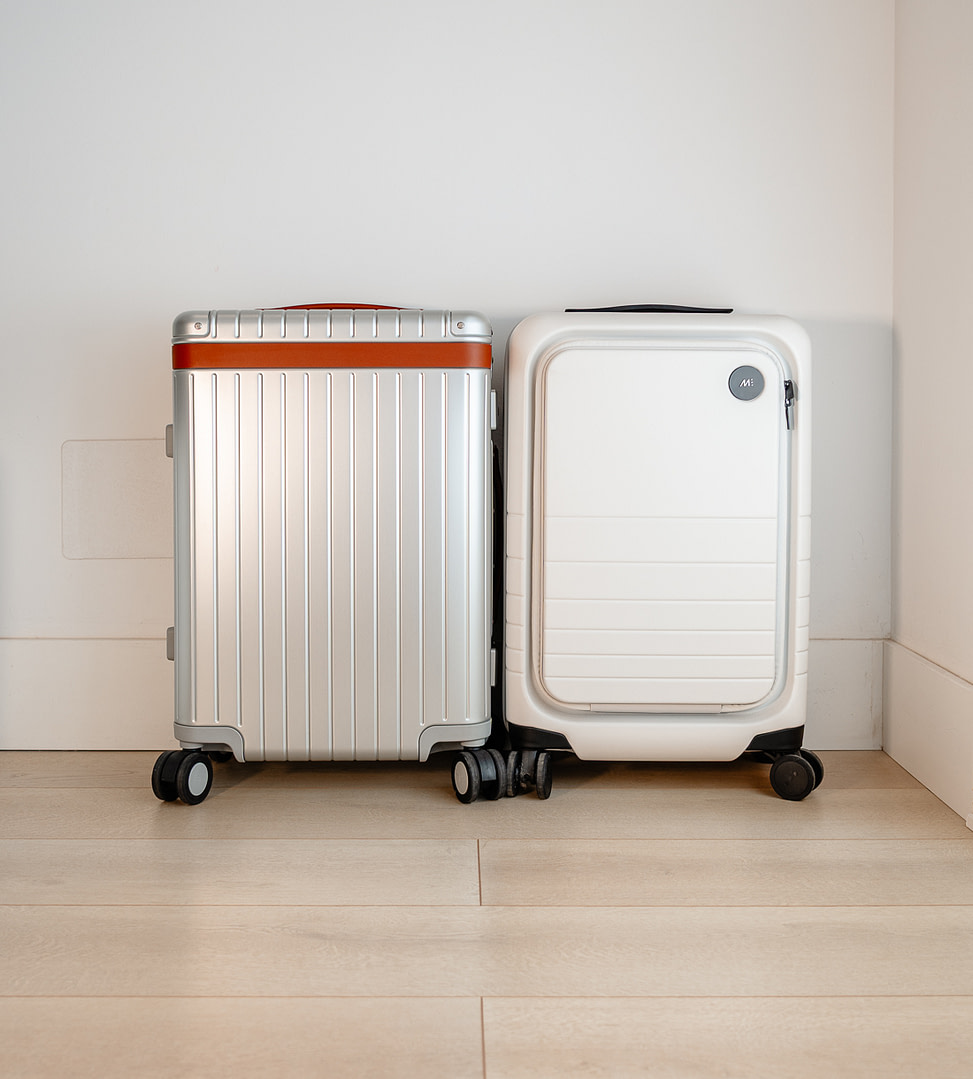
Aluminum vs. Polycarbonate
Swipe to compare →
| Aluminum | Polycarbonate | |
| Weight | Heavier | Lighter |
| Impact behavior | Dents and deforms | Flexes and rebounds |
| Scratches | Usually more visible | Depends heavily on finish |
| Expansion | Rare | Common |
| Closure | Usually latches | Usually zippers |
| Rigidity | Excellent | More flexible |
| Price | Generally expensive | Huge price range |
| Best for | Protection, structure, craftsmanship, design | Low weight, practicality, value, flexibility |
I own and travel with both, and I don’t think one is better across the board.
If I’m flying with a strict cabin-weight allowance or know I’m going to come home with more than I left with, I’ll usually take polycarbonate. If I’m carrying camera gear or simply feel like taking one of my aluminum cases, I’ll take aluminum.
How to Choose an Aluminum Suitcase
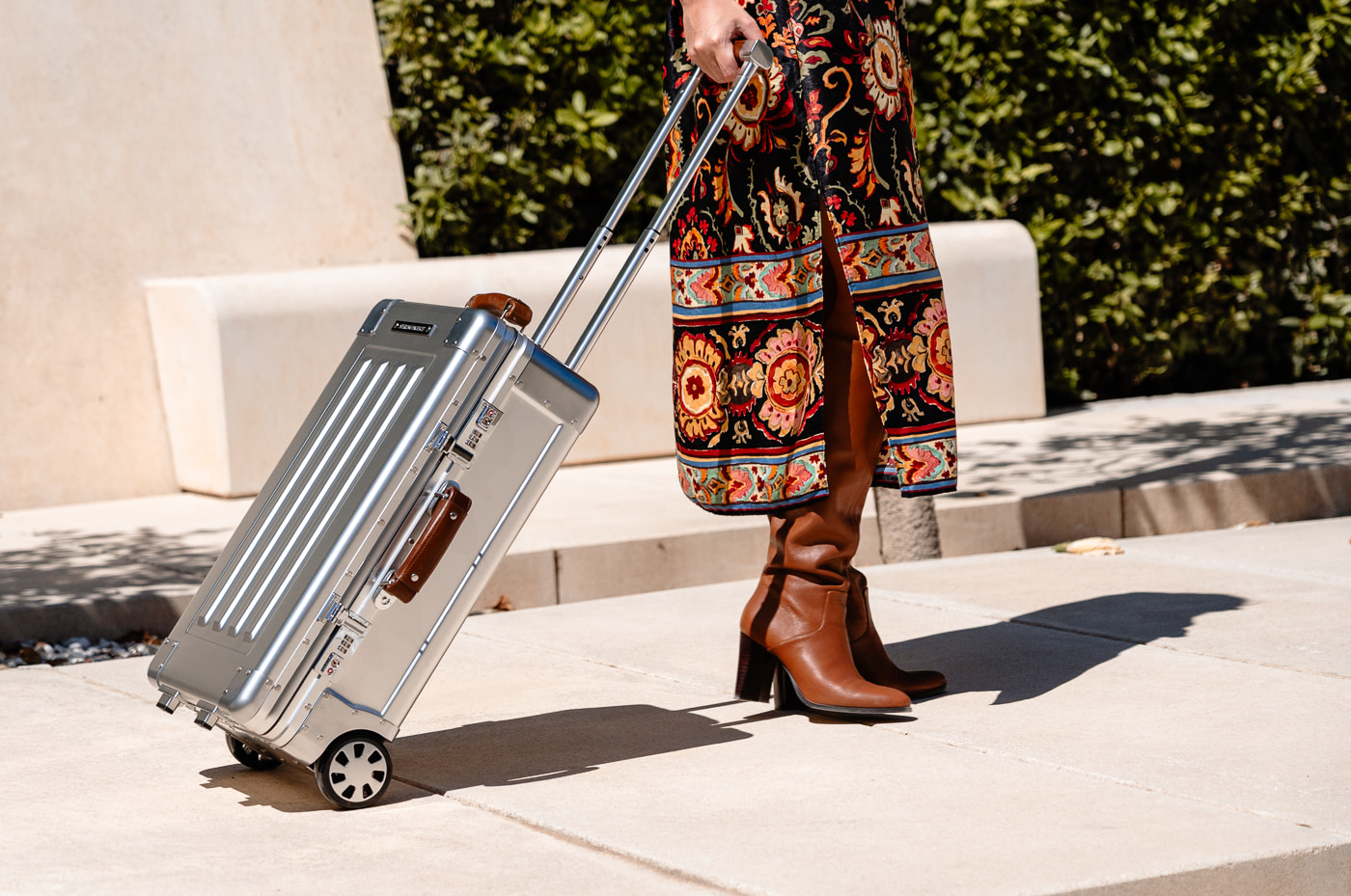
For me, how it looks matters. A lot.
If I’m spending $400, $1,000, or more on an aluminum suitcase, I want to love the design. That’s part of the reason I’m buying aluminum in the first place.
The brand and warranty are important, too. I want a company I trust, a warranty that covers useful things, and ideally, replacement parts if a wheel, handle, or lock eventually needs fixing.
Then I check dimensions and weight. “Carry-on” doesn’t mean the same thing on every airline, and an 11-pound suitcase isn’t much use to me if I only get 15 lb (7 kg) for my cabin bag.
After that, it’s wheels, handles, and latches. I want smooth wheels, a solid telescoping handle, comfortable grab handles, and latches that open and close easily.
Finally, the interior. I’ve used 50/50 layouts, deep 80/20 compartments, compression panels, and Rimowa’s Flex Dividers. They all pack differently, and a good layout can make 35 liters feel surprisingly roomy.
So yes, start with the one you think looks fantastic. Then make sure you’ll enjoy traveling with it.
Final Verdict
One thing I didn’t expect from testing aluminum luggage at such different price points is how little price tells you about how good a suitcase actually is to travel with.
The expensive cases are nicer in ways you can see and feel. The Sterling Pacific’s construction is exceptional. Carl Friedrik gets the small details right. Rimowa feels every bit as well-made as I expected it to.
But spending twice as much doesn’t get you wheels that are twice as good, twice the packing space, or a suitcase that’s twice as useful.
That’s probably the biggest reason the $399 MVST TREVA ended up at the top of this list.
FAQ
What is the best aluminum luggage?
Of the full-aluminum suitcases we’ve tested, I’d recommend the MVST TREVA to most travelers. It has excellent wheels, good organization, full-aluminum construction, and starts at $399.
If craftsmanship matters more than price, I’d choose the Sterling Pacific 35L. For design, my favorite is the Carl Friedrik Aluminum Carry-On.
Is aluminum luggage worth it?
For me, yes. But not for every trip.
If I were choosing purely on practicality, I’d have a hard time justifying the extra cost over a good polycarbonate suitcase. What makes aluminum worth it to me is much simpler: I really enjoy traveling with it.
I like how it looks, how it feels, and all those little details I’ve spent far too much time talking about in this guide.
Is aluminum luggage better than polycarbonate?
Not necessarily. Aluminum is more rigid and protective, while polycarbonate is lighter, more flexible, and usually more practical. I own and travel with both depending on the trip.
Does aluminum luggage dent and scratch?
Yes. Scratches are almost inevitable, and a hard impact can leave a dent. Small dents are usually cosmetic, but a more serious impact can affect the frame or how the case closes.
Is aluminum luggage too heavy for carry-on?
It depends on your airline. Most of the aluminum carry-ons we’ve tested weigh roughly 9 to 11.5 pounds before packing. That’s manageable when an airline has no strict cabin-weight restriction, but much harder to justify when your total allowance is only 15 to 18 lb (7 to 8 kg).
Always check the rules for the airline you’re actually flying.
Is aluminum luggage allowed as a carry-on?
Yes. The material isn’t the issue; the suitcase still needs to meet your airline’s size and weight limits.
Is Rimowa worth the money?
I borrowed a Rimowa Original Cabin for one trip and liked it. The wheels are excellent on smooth surfaces, the stage-free handle is a dream to use, the Flex Dividers are surprisingly practical, and everything feels beautifully made.
Would I pay $1,550 for one? Probably not. It isn’t my favorite suitcase here. But having traveled with one, I understand the appeal and where the money goes. I just haven’t used it long enough to compare it to cases I’ve traveled with for months or years.
Why is aluminum luggage so expensive?
The material and manufacturing process are more complicated than those of most molded plastic suitcases, and aluminum cases typically use metal frames, reinforced corners, integrated latch locks, and more complex hardware.
At the luxury end of the market, you’re also paying for craftsmanship, design, branding, and exclusivity.